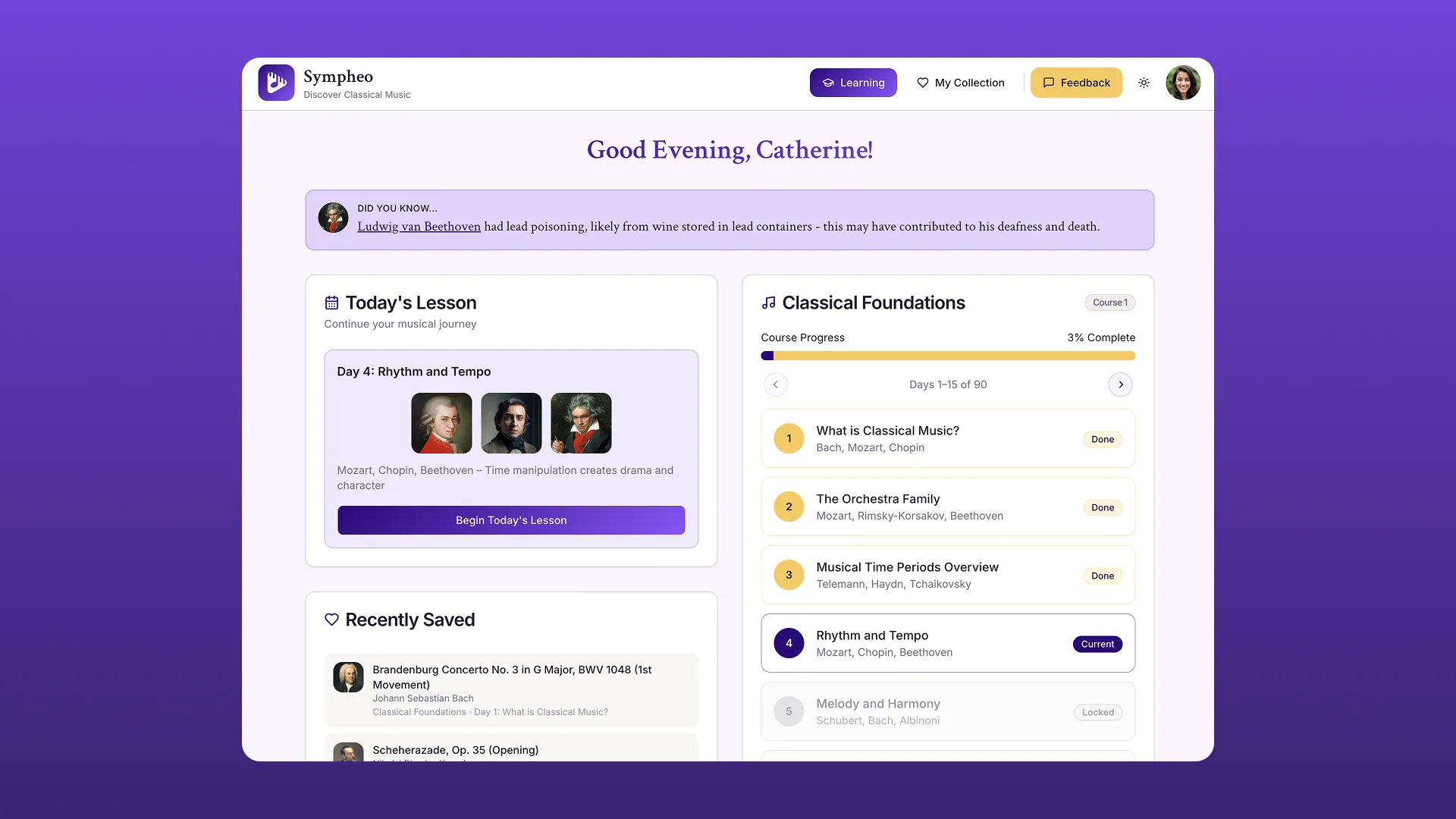
Sympheo was my first end-to-end test of a question I'd been circling for a year: how much product can a single design leader ship, alone, when AI removes the engineering bottleneck? It was deliberately framed as a learning experiment — not a serious attempt at a business venture — so I could find out where the friction actually lives when there's no team to hide it.
The premise
Classical music has a well-documented adoption problem. Adults who'd like to enjoy it report the same barriers: not knowing where to start, feeling judged for not knowing what they're hearing, and finding existing educational content either condescending or academic. I designed Sympheo around a structured 90-day path — short video intros, three curated pieces per day, locked progression, lightweight note-taking — borrowing the daily-habit mechanics that work for language apps and applying them to listening rather than producing.
My role
Everything. Positioning, naming, IA, UX, visual design, build, content strategy, marketing site, beta launch comms. I used Lovable for the application and Figma for the design exploration that fed it. The point wasn't to build something I could've built with a team — it was to learn, hands-on, what an AI-accelerated solo workflow actually feels like end to end.
The decisions worth talking about
Positioning: appreciation, not status
My first draft framed Sympheo around cultural capital — "become conversant," "join the conversation." It tested well as copy and felt completely wrong as a product. The status frame attracts people who want to seem cultured; the appreciation frame attracts people who want to actually enjoy the music. Different products, different retention curves, different word-of-mouth. I rewrote everything toward genuine appreciation. This was the single most consequential decision in the project and the one a non-designer founder would've gotten wrong.
Locked progression as a retention bet
Requiring users to fully listen to each day's three pieces before unlocking the next was a deliberate friction choice. Classical pieces reward attention; skipping defeats the entire premise. The risk was attrition. The bet was that the right user would respect the constraint and the wrong user would self-select out early. I never got to validate this at scale, but I'd make the same call again.
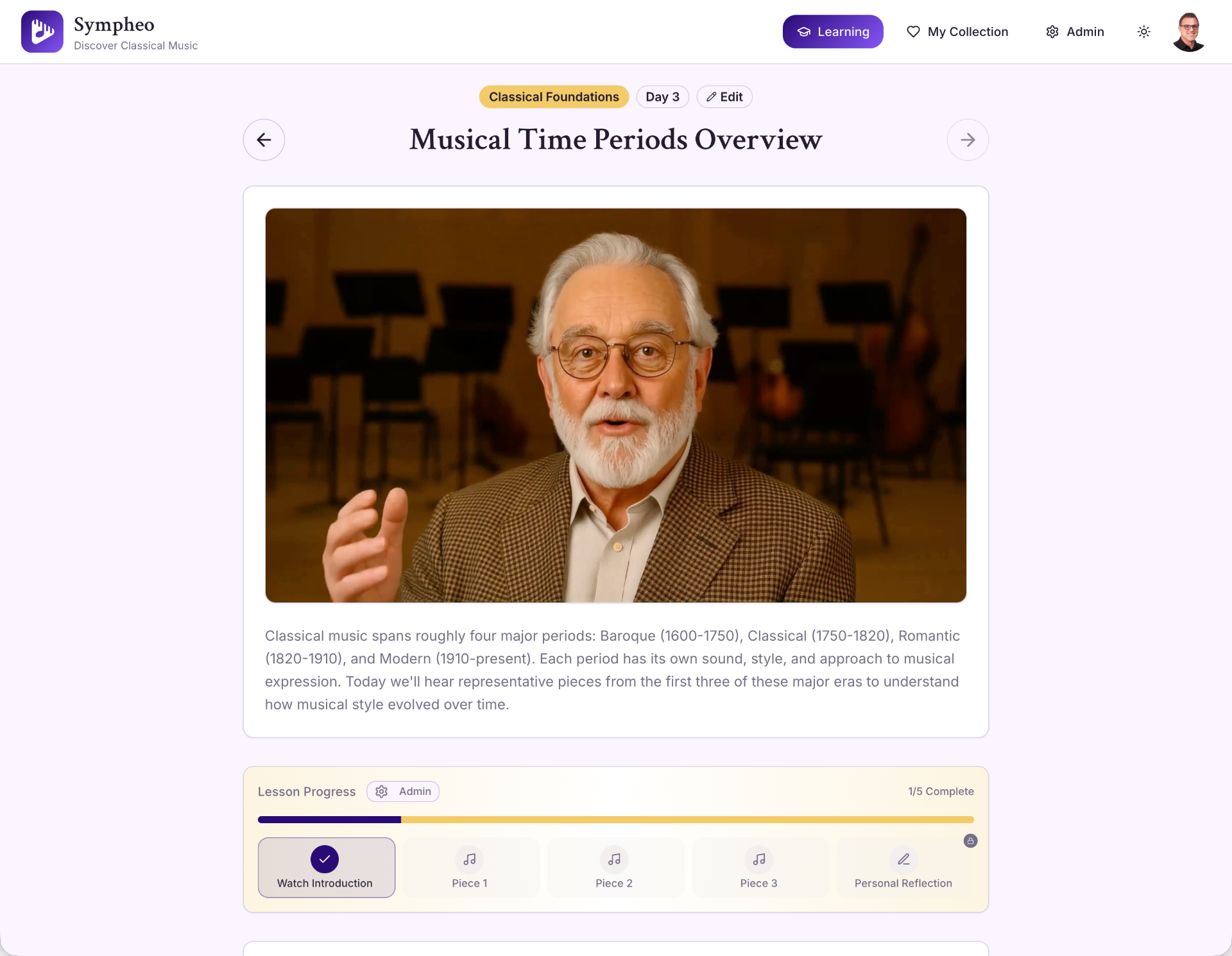
Lesson screen — video intro, structured progression, per-lesson navigation.
Subscription over one-time purchase
Content-light apps usually struggle with subscription justification. I chose it anyway because the daily cadence created a natural monthly rhythm and because AI made ongoing content expansion cheap. The model would've had to earn itself through new "Packs" over time — a fun design problem to sit with, even without commercial pressure to solve it.
Private beta over public launch
Fitting for a learning experiment: small audience, real feedback, no pressure to perform as a brand.
What I built
A working web application: onboarding, lesson player, progress tracking, favorites, notes, account management. A marketing site. A private beta announcement strategy. A naming exploration that landed on Sympheo after the original "Symphio" was taken. The whole thing went from positioning to private beta in a matter of weeks, working evenings and weekends.
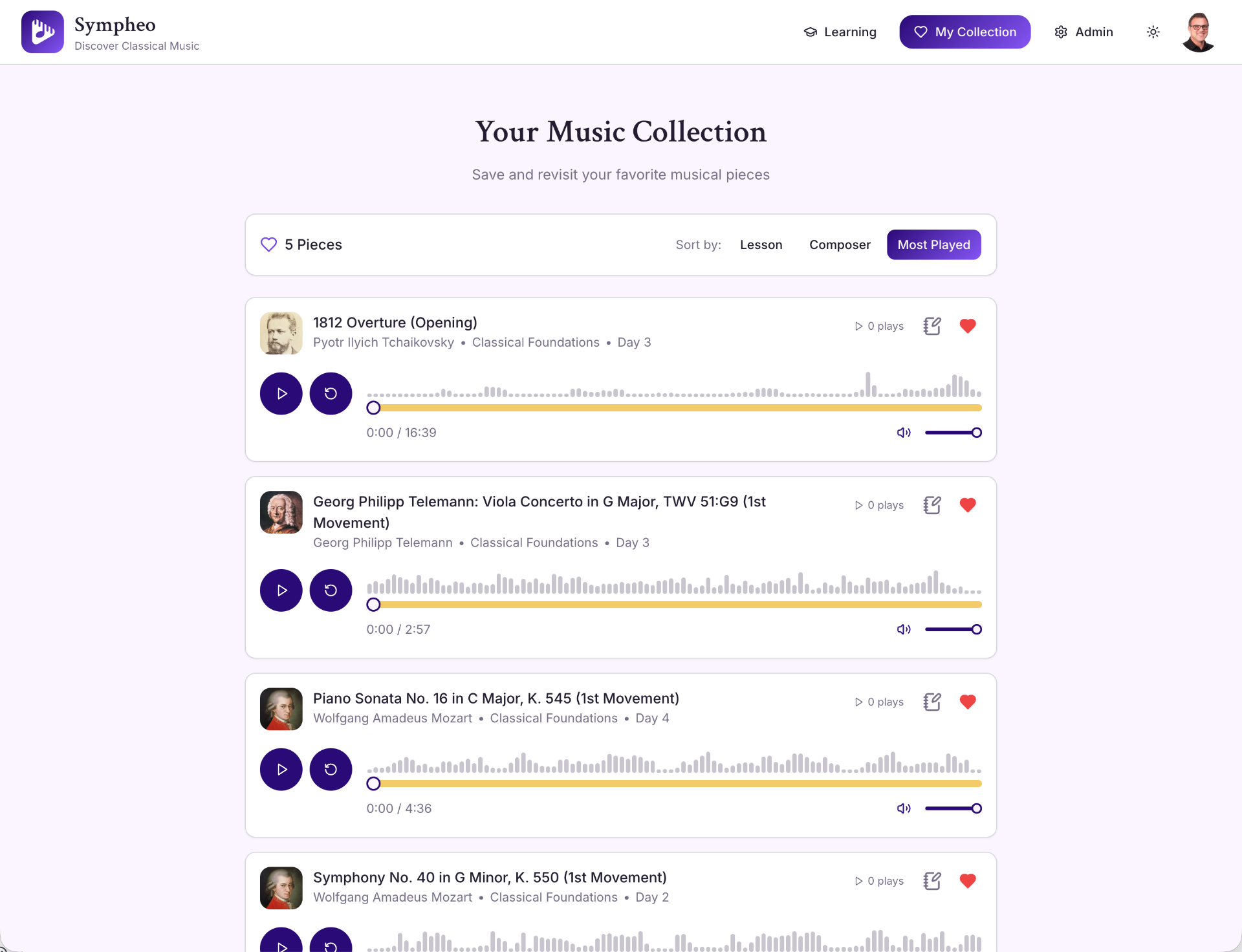
My Collection — saved pieces with inline players, composer metadata, and sort controls.
Current status
Sympheo never went to a commercial release. Once I'd answered the question the experiment was designed to answer, I shelved it to focus on other projects and on bringing what I learned into client and team work. I may eventually release the content for free in a different format so the lessons don't go to waste.
For full honesty: I never validated demand at scale, and a daily classical-listening subscription is a narrow audience to build a business around — which is part of why it stayed an experiment rather than becoming one.
What I kept
The capability. Sympheo proved — to me, concretely, with a working artifact — that a design leader with AI-fluent build skills can take a product from positioning through private beta solo, in a fraction of the time and cost a small team would need. That capability is portable, and it's the real output of the experiment.
I also kept a sharpened instinct for the difference between can build and should build — which, in an era when "can build" is collapsing toward zero for most product categories, is becoming the more valuable of the two.