The challenge: Create an immersive assessment platform from nearly nothing
A two-person startup needed me to turn a weeks-long manual assessment creation process into a platform that could create them in hours
Skillcraft had proven the science worked. Their psychometric skill assessment system impressed one of the world's largest sales training companies and suddenly they were truly in business. The problem was: authoring assessments meant hand-editing spreadsheets and raw JSON files. It took the founder weeks to create a single assessment, and only he knew how to do it. My mandate was to create a fully-designed and fully-functional platform to 10x the pace of assessment creation and create a modern, engaging end user experience.
The editor: laying the foundation
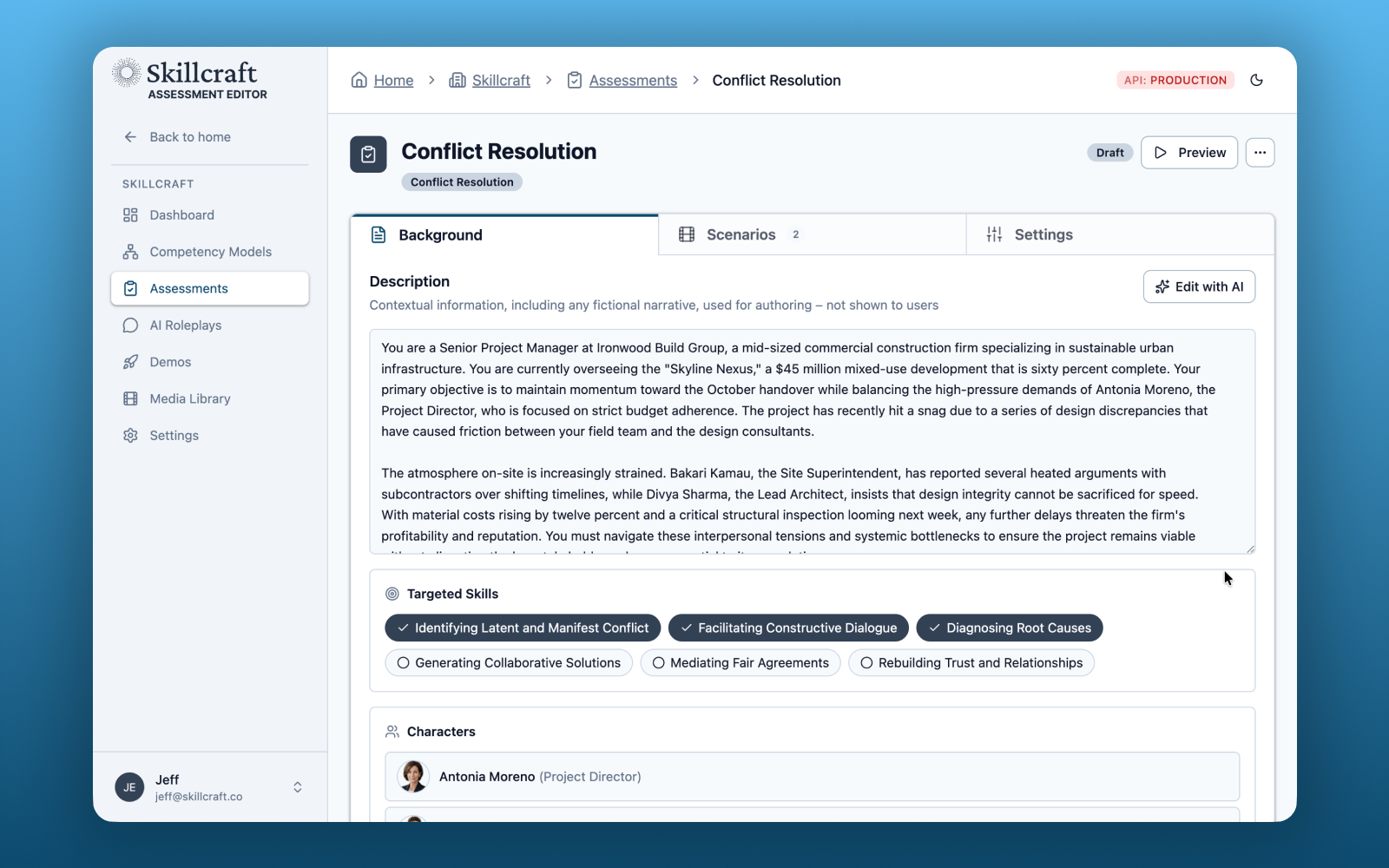
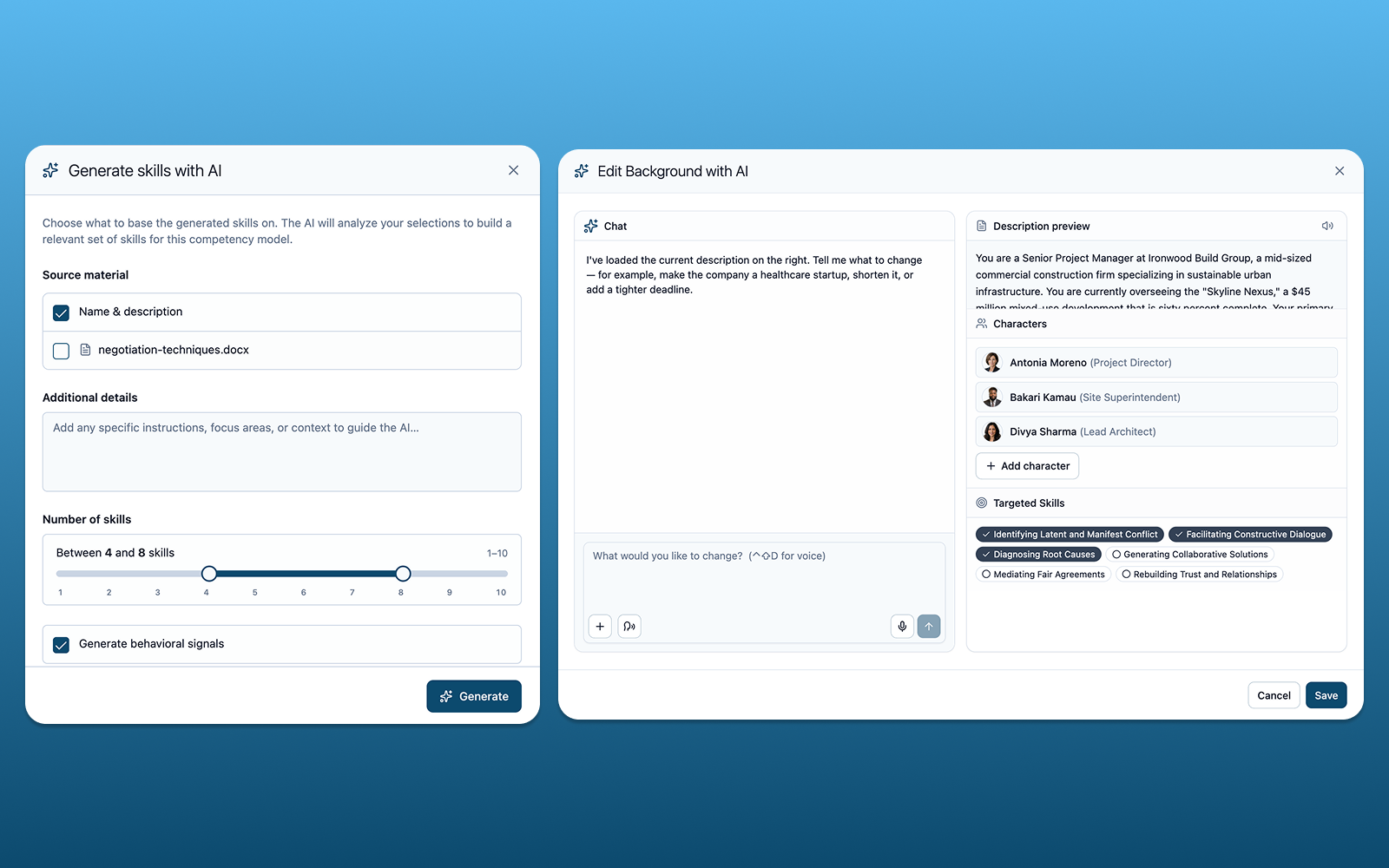
First, I defined what an assessment was, then I added an AI collaborator at every level to help build them.
Before I could build a tool for making assessments, I had to decide what an assessment actually was. The structure had to be flexible enough to contain a variety of formats — a quick screening quiz is very different from a multi-act day-in-the-life simulation — but simple enough that a non-expert could hold the whole shape in their head and edit it without a manual. And then I used AI assistant tools to create and combine fictional narratives with our psychometric analysis model (skill → behavioral signals → interactions → rubrics).
The simulation engine
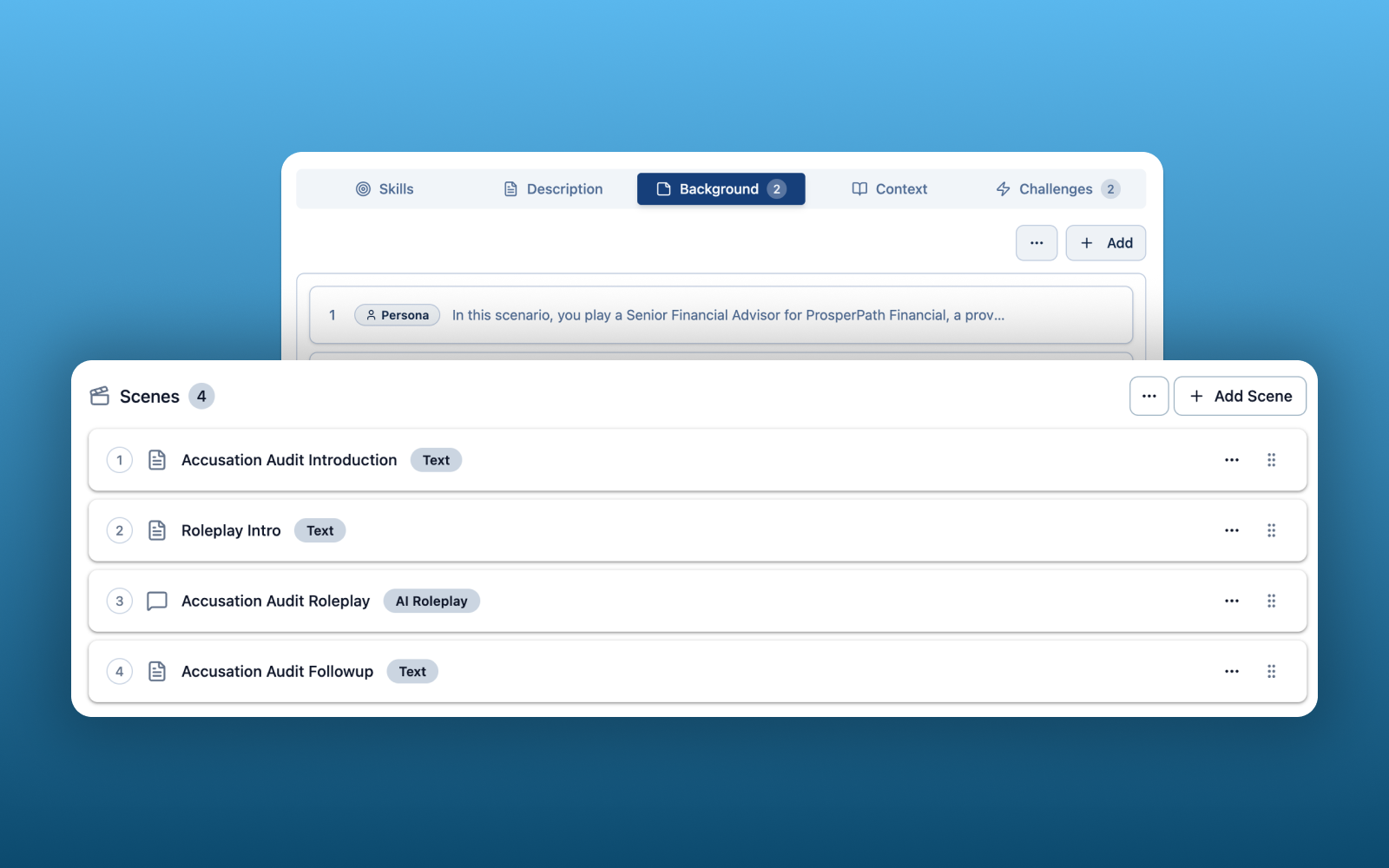
I built a system for defining simulation challenges that allowed us to roll out entirely new assessment methods in hours (or less)
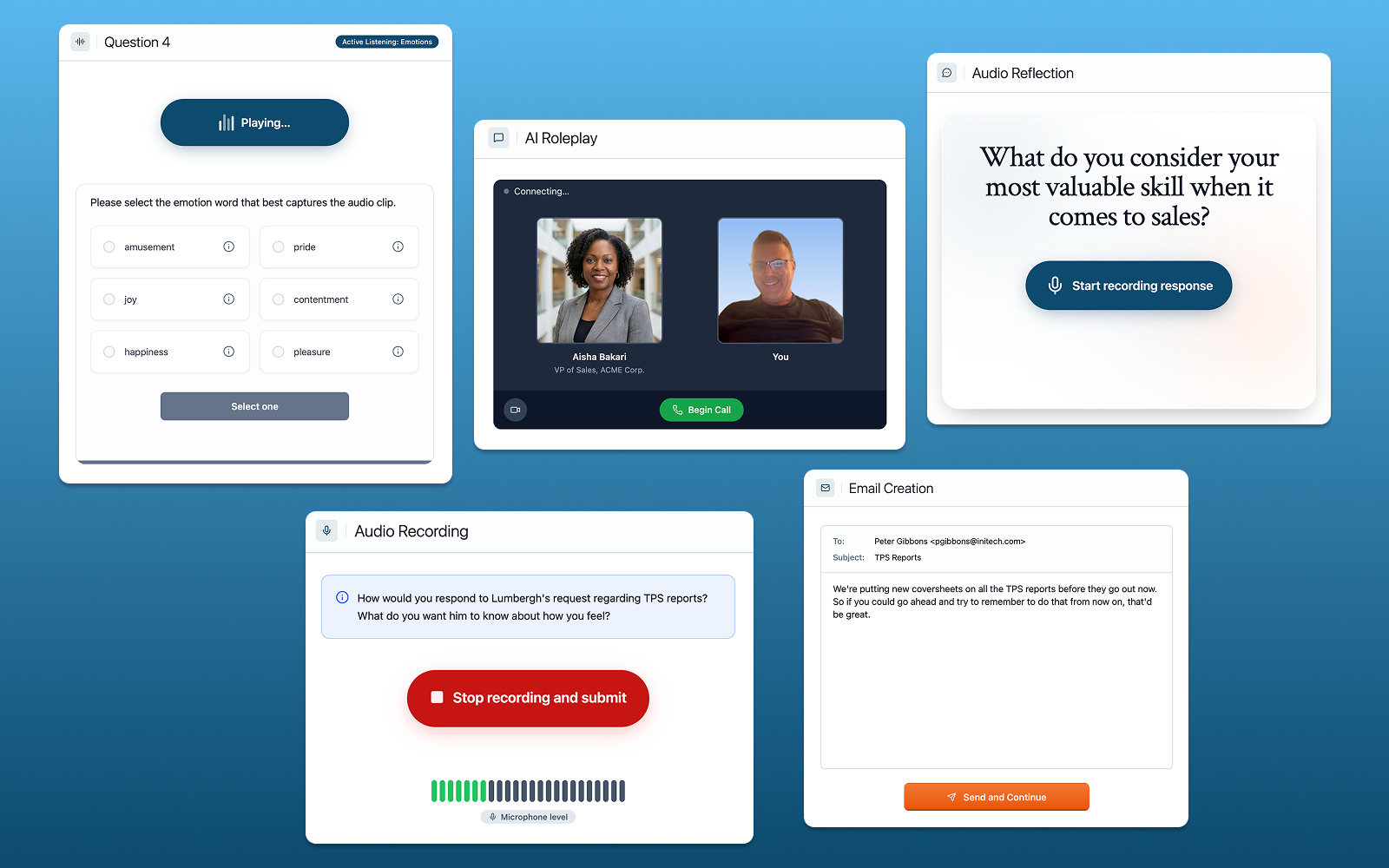
A quiz can't assess how someone handles a hostile stakeholder. A conversation can't measure someone's writing skills. The Skillcraft assessment player was designed for infinite expansion – new types of simulations could be created as new types of skills needed to be analyzed.
By creating a standardized data structure for defining simulations based on their component parts, I made it possible to simultaneously generate the end user experience and the necessary editing UI for new simulation formats with just a handful of AI prompts.
Entirely new types of interactive simulations could be created almost as quickly as customizing existing ones.
AI roleplays: from avoided to essential
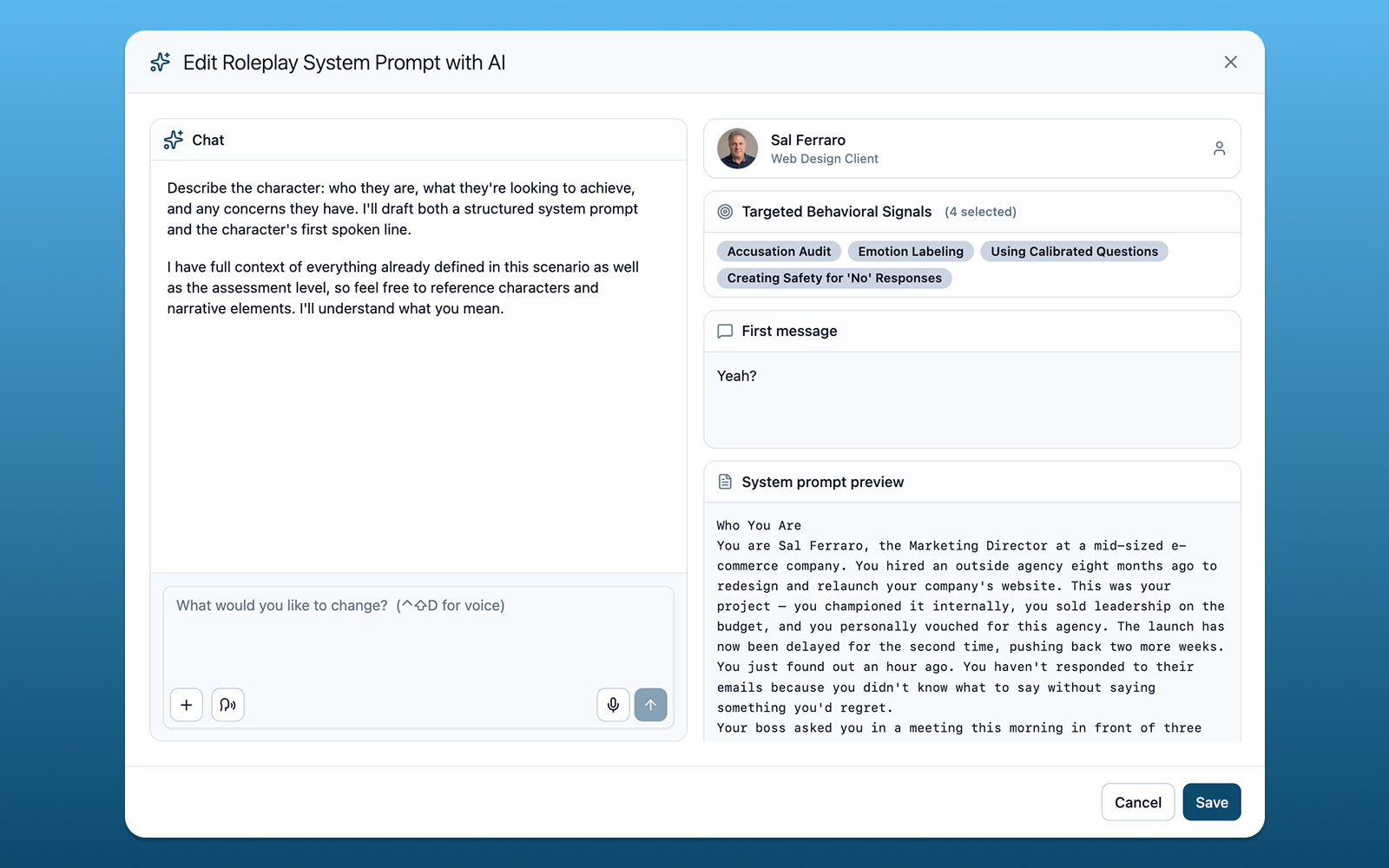
Skillcraft initially avoided AI roleplay simulations, as they are difficult to evaluate reliabily. But once we cracked the code, they became a centerpiece
AI roleplays are a common tool used in sales training (Skillcraft's first target market), but they are rarely analyzed in a way that provides rigorous data due to their unpredictable nature. Facing overwhelming demand from potential customers, we devised a proprietary way to get predictable results from unstructured conversations, and I created an AI assistant to create deep, complex characters by leveraging pre-existing narrative information already established within the assessment scenarios.
The player: A skill test, not a memory test
Everything about the assessment player was designed to maximize the user's focus on what matters
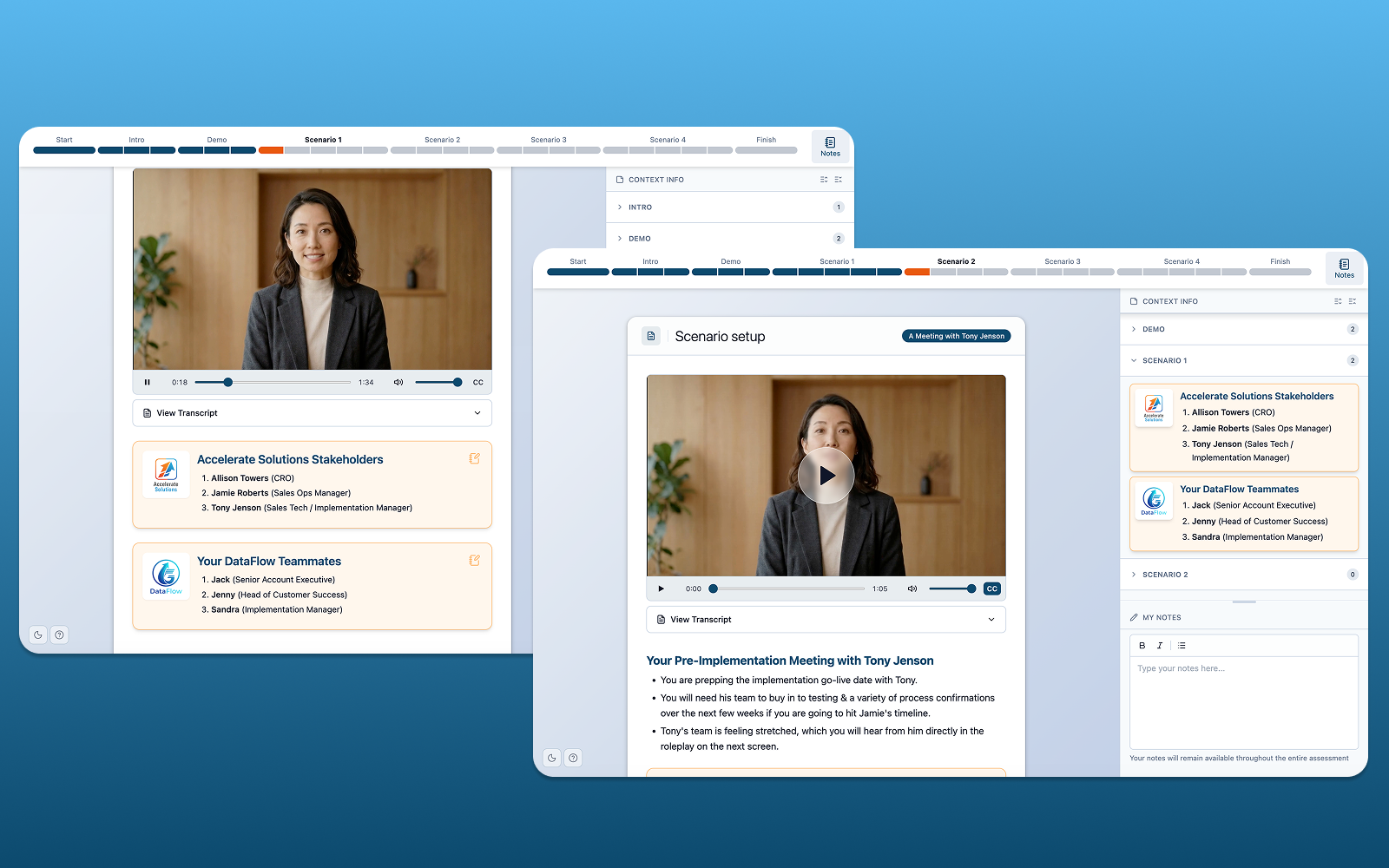
A standardized skill assessment necessarily asks participants to imagine themselves in scenarios that don't match their real jobs, employers, or priorities. But the point of a skill assessment isn't to test people's ability to memorize fictional narratives, so I developed a concept called "context cards" – where narrative content is transferred to a persistent side panel for quick reference, along with an area for the user to take freeform notes. Additionally, I introduced an AI-generated video narrator (created using ElevenLabs and HeyGen) to avoid requiring the participant to read large amounts of text to obtain necessary context. A transcript is provided, however, for those who prefer written content.
Making the platform safe at any development speed
Skillcraft's CTO and I collaborated on a code architecture where AI-accelerated development and a robust backend could coexist.
Skillcraft was very forward thinking. They knew that without my highly accelerated approach to front end development and iteration, they couldn't compete with larger competitors or meet the demanding expectations of their largest customers. I was given complete control of the front end experience, and permission to iterate freely, with minimal oversight.
But rapid-fire development is inherently risky. That's why we developed a system where I had complete control over the user experience, but when it came to accessing and saving data, it all happened through carefully crafted SOC2-compliant API with redundant security features.
I'm convinced this model will be future of software development, and hope to bring it to other similarly forward-thinking companies.
Results
8 weeks
Concept to shipped platform, singlehandedly
$2M
Qualified enterprise pipeline generated
90%
Reduction in custom assessment build time
The platform that I created for Skillcraft not only enabled a compelling experience for assessment takers, it became the company's primary sales instrument almost immediately — opening opportunities that were completely inaccessible just a few months earlier.
It gave Skillcraft a uniquely competitive offering. No other product in its category offered an AI-native creation platform with a flexible interaction layer supporting both role-play and multimodal simulations, with fully customizable evaluation methodologies.
It opened a market Skillcraft couldn't reach. The demo built on the new platform directly enabled first meetings with six Fortune 500 prospects, generating $2M in qualified pipeline at deal sizes between $200K and $600K — a segment with no reliable access before launch.
It led to a major expansion investment by a strategic partner. The modernized experience inspired a key partner to commit to a six-figure expansion deal and to accelerate the rollout of the platform to their own customers.
It stayed enterprise-ready throughout. Partnered with engineering to keep the AI-native stack SOC 2–aligned — a prerequisite for every one of those Fortune 500 conversations.
An assessment that took the CEO two weeks now took under a day — roughly 10x. But the speed was never the point; what it bought was. Fast enough that a non-expert could stand up a credible, end-to-end assessment on demand — exactly what an early-stage company chasing its next idea needed.